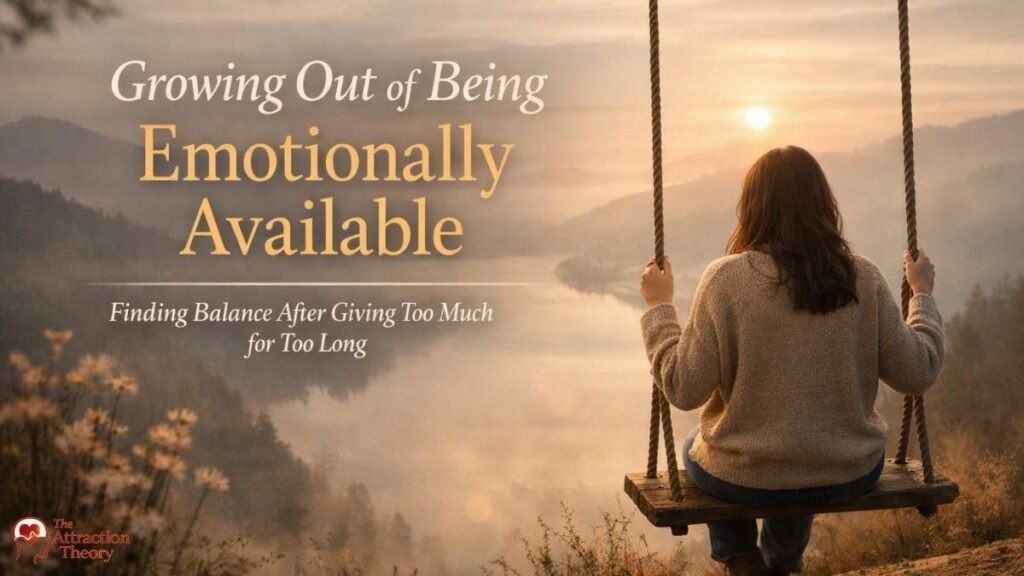
Most people don’t realise they’re emotionally available.
They just think they’re being mature.
Understanding.
Present.
At some point in life, almost everyone enters this phase.
You listen more than you speak.
You notice shifts in mood.
You try to be patient, supportive, emotionally present — even when it costs you something.
At first, it feels right.
You feel grown.
Evolved.
Like you finally understand how relationships and people work.
This is usually the phase where people become emotionally available.
Not as a label — as a behaviour.
You show up.
You respond.
You hold space.
And slowly, without realising it, you start paying a price.
Most people go through this phase in real life.
In their first serious connection.
In early adulthood.
Sometimes after a breakup, sometimes before one.
No one warns you that being emotionally available comes with a cost.
Not a dramatic cost.
Not something that breaks you overnight.
A quiet one.
You start adjusting more.
You start understanding more than you’re understood.
You start carrying emotional weight that isn’t always yours.
Psychologically, this is a normal phase.
It’s how people learn empathy.
It’s how they learn presence.
It’s how they learn emotional depth.
But it’s also where many people confuse care with responsibility, and availability with self-sacrifice.
That’s why this article isn’t about blaming emotional availability.
It’s about recognising a phase that almost everyone passes through — and understanding why people eventually move out of it.
Not because they stop caring.
But because they start noticing what it costs.
If you’ve ever felt tired without knowing why,
felt emotionally present but quietly drained,
or wondered when being “there for others” started leaving less space for you —
you’re not alone.
You’re not broken.
You’re probably just in a phase that most people experience…
and eventually grow out of.
Why Emotional Availability Feels Like Growth at First
In the beginning, emotional availability feels like progress.
You compare yourself to who you used to be —
less reactive, less selfish, less guarded.
Now you listen.
You pause before responding.
You try to understand where the other person is coming from.
It feels mature.
Psychologically, it is a form of growth.
You’re learning empathy.
You’re learning regulation.
You’re learning that relationships aren’t just about what you feel.
This phase usually comes after something shifts in real life.
A first heartbreak.
A serious connection.
A moment where you realise that emotional distance hurts more than emotional effort.
So you swing the other way.
You become more present.
More patient.
More available.
And because this is new for you, it feels meaningful.
People respond to it too.
They open up more.
They lean on you.
They feel safe with you.
That feedback reinforces the behaviour.
You start believing:
“This is how good relationships work.”
“This is who I’m supposed to be now.”
Nothing feels wrong yet.
Because at this stage, availability is still a choice, not an obligation.
You’re giving — but you’re not empty.
You’re showing up — but you’re not overextended.
You still feel like yourself.
That’s why this phase is confusing later on.
Because it doesn’t start unhealthy.
It starts aligned.
Only over time does the balance begin to shift.
And most people don’t notice that shift while it’s happening —
because they’re too busy trying to do the right thing.
The Cost Starts Showing Up Quietly
The cost of being emotionally available doesn’t arrive all at once.
There’s no moment where you suddenly think, “This is too much.”
It shows up in small, easy-to-ignore ways.
You start replying even when you’re tired.
You stay present even when you need space.
You push your own feelings aside because “this isn’t the right time.”
At first, it still feels reasonable.
You tell yourself:
“They’re going through something.”
“I can handle this.”
“It’s not a big deal.”
And maybe, individually, none of it is.
But psychologically, something shifts.
Your emotional availability slowly stops being a choice
and starts becoming a default role.
You’re the one who listens.
The one who understands.
The one who keeps things emotionally stable.
And because you’re capable of it, people lean more.
Not out of malice.
Out of habit.
This is where the cost begins.
Not in exhaustion — yet.
In imbalance.
You start noticing that you know more about their inner world
than they know about yours.
You notice that you’re adjusting more than you’re being adjusted for.
You’re still emotionally present, but something feels off.
You don’t feel angry.
You don’t feel hurt enough to complain.
You just feel… quietly tired.
This is the stage most people don’t talk about.
Because from the outside, you look fine.
You look mature.
You look supportive.
But internally, you’re spending more emotional energy
than you’re getting back.
And because this phase feels normal,
most people stay in it longer than they should —
not realising they’ve already started paying the cost.
Why Emotionally Available People Attract Emotionally Unavailable Ones
This part feels uncomfortable to admit.
But it happens to a lot of people.
When you’re emotionally available, you create safety.
You’re calm.
You’re patient.
You don’t pressure.
And safety is attractive — especially to people who don’t know how to provide it themselves.
Emotionally unavailable people often aren’t cold or careless.
They’re usually unsure, guarded, or inconsistent with their own feelings.
So when they meet someone who can listen, understand, and stay steady, they relax.
They lean in — but only as much as feels comfortable to them.
Psychologically, this creates a familiar pattern.
One person becomes the emotional stabiliser.
The other stays slightly distant.
Not intentionally.
Just naturally.
You give clarity.
They bring ambiguity.
You communicate openly.
They communicate when they feel like it.
And because you’re emotionally available, you try to bridge the gap.
You explain more.
You adjust more.
You wait more.
Not because you’re desperate —
but because you believe connection requires effort.
The imbalance doesn’t feel obvious at first.
You tell yourself:
“They just need time.”
“They’re not used to opening up.”
“They’ll meet me here eventually.”
But the truth is, availability and unavailability often attract because they fit.
One provides what the other lacks.
One holds space.
One avoids it.
Over time, this dynamic costs the available person more.
Not because they’re giving too much —
but because they’re giving into a system that doesn’t return the same depth.
And most people don’t realise what’s happening until they’re already tired.
This isn’t about blaming either side.
It’s about recognising a very common real-life pattern —
one that many people grow out of only after experiencing it themselves.
When Availability Slowly Turns Into Self-Abandonment
This is the part people usually miss while they’re in it.
You don’t wake up one day and decide to ignore yourself.
It happens gradually.
You start choosing the “right moment” to speak —
and that moment keeps getting delayed.
You downplay your needs because theirs feel heavier.
You tell yourself, “I’ll deal with this later.”
Later rarely comes.
Psychologically, this makes sense.
When you’re emotionally available, you’re trained to stay regulated.
To not react impulsively.
To not make things worse.
So instead of expressing discomfort, you manage it internally.
You become good at it.
Too good.
You stop asking for reassurance because you don’t want to seem needy.
You stop naming hurt because you don’t want to create pressure.
You stop expecting consistency because you’ve learned to adapt.
From the outside, this looks like emotional maturity.
From the inside, it feels like shrinking.
You’re still present.
Still kind.
Still understanding.
But you’re less honest with yourself.
Not because you’re lying —
but because honesty feels inconvenient in this dynamic.
This is where availability quietly crosses into self-abandonment.
Not in a dramatic way.
In a practical one.
You keep the connection smooth by absorbing the discomfort yourself.
And the longer this goes on, the more normal it feels.
Until one day you realise something unsettling:
You’ve been emotionally present for someone else
while being emotionally absent from yourself.
That’s usually the moment people start pulling back.
Not out of anger.
Not out of bitterness.
Out of exhaustion.
And that’s often how this phase begins to end —
quietly, without anyone doing anything “wrong.”
The Invisible Reward That Keeps You There
Even when it’s draining, emotionally available people don’t leave easily.
There’s a reason for that.
Being emotionally available comes with a quiet reward.
You feel needed.
You feel trusted.
You feel like the “safe place.”
Psychologically, this matters.
Being needed gives a sense of purpose.
Being the one who understands feels validating.
Being emotionally mature becomes part of your identity.
You tell yourself:
“At least I’m doing the right thing.”
“At least I’m not avoiding.”
“At least I care.”
That identity is hard to give up.
Because walking away doesn’t just mean losing a person —
it means losing the role you’ve been playing.
And roles are comforting, even when they cost us.
You start measuring your value by how well you hold things together.
By how patient you are.
By how much you can handle without breaking.
That’s the invisible reward loop.
The more you give, the more responsible you feel.
The more responsible you feel, the harder it is to step back.
Not because you’re stuck —
but because leaving feels like failure.
Failure to be understanding.
Failure to be supportive.
Failure to be “emotionally evolved.”
Most people don’t recognise this as a reward.
But it is.
It keeps you invested even when the connection stops feeding you.
And until you see that reward clearly,
you’ll keep paying the cost without questioning why you’re staying.
That’s usually the moment awareness starts replacing obligation.
And once obligation fades,
this phase naturally begins to loosen its grip.
Why This Phase Ends for Almost Everyone
Most people don’t decide to stop being emotionally available.
It just stops working.
One day, you notice you’re tired in a way sleep doesn’t fix.
You notice conversations feel heavy instead of meaningful.
You notice that showing up doesn’t feel like choice anymore — it feels like duty.
That’s usually the beginning of the end of this phase.
Not because you’ve become cold.
Not because you’ve stopped caring.
But because your system has learned something important.
It’s learned that emotional availability without reciprocity leads to depletion.
That empathy without exchange becomes strain.
That presence without being met slowly disconnects you from yourself.
Psychologically, this is a natural correction.
At first, people learn to care by over-giving.
Later, they learn to care by calibrating.
This phase doesn’t end with a dramatic boundary or a big speech.
Most of the time, it ends quietly.
You reply a little slower.
You stop explaining as much.
You notice your own feelings sooner.
Not out of spite —
out of self-preservation.
And that’s how most people move out of this phase in real life.
They don’t announce it.
They don’t label it.
They just stop doing emotional work that isn’t being shared.
This is why almost everyone passes through this stage.
It’s part of learning how connection actually works.
First, you learn how to be present.
Then, you learn when presence needs to be mutual.
And once that understanding settles in, emotional availability doesn’t disappear.
It just stops costing you your sense of self.
That’s not losing empathy.
That’s growing out of imbalance.
What Changes After This Phase (Without You Forcing It)
After this phase, something shifts quietly.
You don’t become less caring.
You don’t turn emotionally distant.
You don’t lose empathy.
You just stop over-functioning.
You start noticing your own internal signals sooner.
Fatigue doesn’t get ignored.
Discomfort doesn’t get justified away.
You don’t rush to explain yourself as much.
You don’t rush to hold space when your own space feels crowded.
And the biggest change is this:
You stop confusing emotional availability with emotional responsibility.
You realise that being present doesn’t mean carrying everything.
That understanding someone doesn’t require abandoning yourself.
That care is healthiest when it moves both ways.
Psychologically, this is integration.
You’re not rejecting the emotionally available version of yourself.
You’re refining it.
You keep the empathy.
You keep the awareness.
But you add boundaries — not as rules, but as instincts.
This is why people who move out of this phase often feel calmer, not colder.
They still care deeply.
They just don’t disappear inside that care.
And that’s usually when relationships start feeling lighter.
Not because people change —
but because you stop doing emotional labour that was never meant to be one-sided.
This is how the phase completes itself.
Not with bitterness.
Not with distance.
With balance.
How This Phase Usually Starts Ending
This phase doesn’t end suddenly.
There’s rarely a clear moment where you decide, “I’m done being emotionally available.”
For most people, it fades.
You just start noticing a certain kind of tiredness.
Not the kind sleep fixes.
The kind that comes from always adjusting.
You realise you’ve been managing emotions more than sharing them.
Holding space more than being held.
Staying regulated even when something inside you feels off.
That awareness doesn’t arrive loudly.
It shows up quietly, in small pauses.
I remember noticing it in myself — not as frustration, but as clarity.
I wasn’t angry.
I wasn’t hurt enough to leave.
I was just aware of how much I was carrying without being asked.
That’s usually the turning point.
Not when something breaks —
but when you stop ignoring what it costs.
You also notice something unexpected.
When you step back slightly, nothing collapses.
The connection doesn’t instantly disappear.
The world doesn’t fall apart.
What changes is internal.
You feel less responsible for managing the emotional atmosphere.
Less alert.
Less on duty.
That’s when people realise this phase is ending.
Not because they stopped caring —
but because they stopped over-functioning.
Looking back, most people don’t regret being emotionally available.
It taught them empathy.
Depth.
Presence.
But it also taught them a harder lesson:
That availability without reciprocity slowly drains you.
So when people say, “I’m different now,”
what they often mean is,
“I learned when to include myself in the care.”
That’s not becoming distant.
That’s emotional maturity settling into balance.
Final Reflection
Being emotionally available isn’t a mistake.
It’s a phase most people pass through when they’re learning how to care deeply, how to stay present, and how to connect without running away.
At first, it feels like growth.
Then it feels like responsibility.
And slowly, it starts feeling heavy.
Not because something is wrong with you —
but because availability without balance always costs something.
This phase doesn’t end with bitterness or withdrawal.
It ends with awareness.
You don’t stop caring.
You stop over-carrying.
You learn that empathy works best when it moves both ways.
That presence doesn’t require self-erasure.
That being emotionally available should not mean being emotionally exhausted.
Most people don’t announce this shift.
They just become quieter inside.
More selective.
More honest with themselves.
And that’s not closing off.
That’s emotional maturity finding its shape.
If you’re in this phase right now, there’s nothing to fix.
You’re not late.
You’re not broken.
You’re learning where care ends and self-respect begins —
a line almost everyone has to discover on their own.
FAQ