
There’s a phase where you don’t feel settled anywhere.
You’re not unhappy exactly. But you’re not comfortable either.
You keep thinking about moving out. Not dramatically — just quietly, in between normal days.
Sometimes it feels very clear.
You tell yourself, “I can’t stay here forever.”
You imagine a new place, a fresh start, a little more space — mentally and emotionally.
And for a moment, that idea feels relieving.
But then, another thought comes in.
“What if I’m overthinking?”
“What if staying is actually the safer option?”
“What if leaving makes things harder instead of better?”
So you stop yourself.
This is the strange part.
You want to move out.
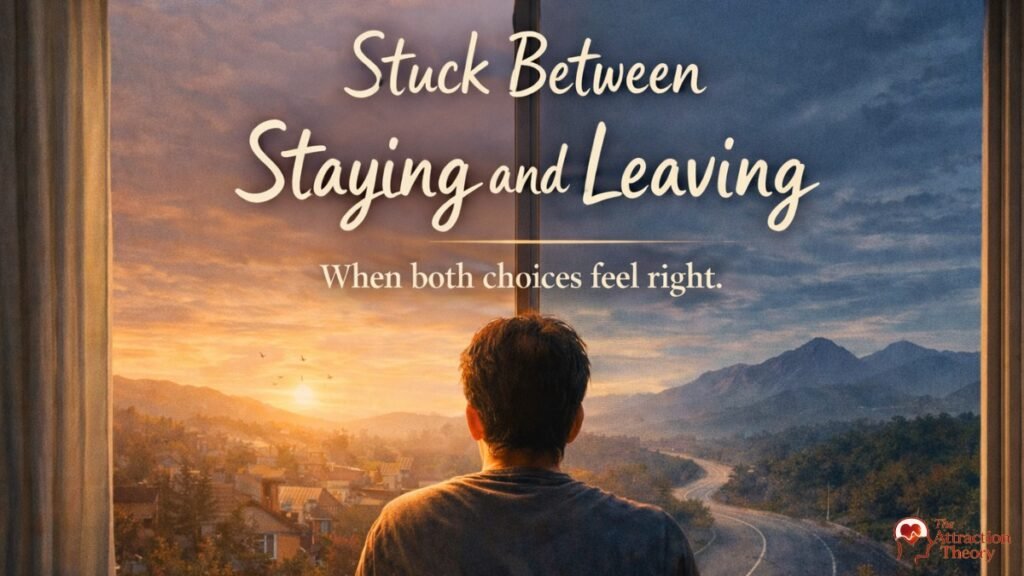
And at the same time, you want to stay.
Some days, staying feels fine.
The place is familiar. The routine works. You know how things function here.
There’s a comfort in knowing what to expect, even if it’s not perfect.
And some days, staying feels suffocating.
Like you’re repeating the same day again and again.
Like you’re slowly getting used to something you never wanted to get used to.
That’s when the thought comes back: Maybe I should leave.
But leaving isn’t easy either.
Leaving means uncertainty.
It means starting again.
It means risking the possibility that things won’t magically improve.
So you stay stuck in between.
Not because you don’t know what you want —
but because both choices carry a cost, and you can feel both of them.
You’re not lazy.
You’re not confused.
You’re just emotionally pulled in two directions at the same time.
Most people around you won’t understand this.
They’ll say things like, “If you want to leave, just leave.”
Or, “If you’re staying, stop complaining.”
But what they don’t see is this quiet conflict inside you.
Because the truth is,
this isn’t just about a place.
It’s about the version of yourself that feels safe here
and the version of yourself that knows there’s more out there.
And right now, you don’t know which one you’re ready to listen to.
Why Staying Feels Comfortable (Even When It’s Not Right)
Staying often doesn’t feel like a choice.
It feels like the default.
You already know the place.
You know the people.
You know how days move here.
Nothing surprises you too much.
And that familiarity brings a strange kind of comfort.
Even if things aren’t ideal, at least they’re predictable.
You know what your mornings look like.
You know what your evenings feel like.
You know how to adjust, how to manage, how to get through the day.
That matters more than we admit.
Sometimes staying feels easier because you’ve already learned how to survive here.
You’ve adjusted your expectations.
You’ve lowered certain hopes.
You’ve told yourself, “It’s not that bad.”
And maybe it isn’t.
But comfort doesn’t always mean happiness.
Sometimes it just means you’ve stopped fighting the discomfort.
There’s also an emotional reason people stay.
This place holds memories.
A version of you already exists here.
Leaving doesn’t just mean changing location —
it means leaving behind a version of yourself that you’re familiar with.
And that can feel heavier than expected.
So you stay.
Not because you love it here.
But because you know how to be here.
Another quiet reason staying feels right is fear.
Not loud fear.
Not panic.
Just the soft fear of “What if I make the wrong decision?”
Staying feels like a way to delay that risk.
As long as you don’t move, nothing changes.
And when nothing changes, nothing completely falls apart.
At least, that’s what it feels like.
Staying also gives you an excuse to not decide yet.
You tell yourself:
“I’ll move later.”
“I’ll think about it when things are clearer.”
“I’m not ready right now.”
And that feels reasonable.
Because deciding means closing one door —
and staying keeps all doors slightly open.
Even if none of them are fully satisfying.
This is why staying can feel right even when something inside you knows it’s not enough.
It’s familiar.
It’s manageable.
It doesn’t demand courage today.
And sometimes, that’s exactly why people stay longer than they planned to.
Why Leaving Feels Necessary (Even When It’s Scary)
There are moments when staying starts to feel heavy.
Nothing big happens.
No fight. No breaking point.
Just a quiet realization that keeps coming back.
If I stay here longer, I’ll start losing something.
Sometimes I can’t even explain what that “something” is.
It’s not a job issue.
It’s not about people.
It’s not even about comfort.
It’s about movement.
I notice it on ordinary days.
When everything is functioning, but I feel stuck.
When days start blending into each other.
When I catch myself thinking, “Is this it?”
That’s when the urge to leave shows up.
Not as excitement — but as pressure.
A pressure that says:
You’re meant to move.
You’re meant to change something.
You can’t stay in the same emotional place forever.
Leaving starts to feel necessary because staying begins to feel limiting.
Not externally — internally.
I feel like I’m adjusting too much.
Like I’m learning how to fit instead of how to grow.
And the more I adjust, the more uncomfortable it becomes.
That’s when the thought forms clearly:
Maybe leaving is the only way I’ll feel like myself again.
Leaving also feels like honesty.
There’s a part of me that knows I’ve outgrown certain things.
Certain routines.
Certain versions of myself.
Staying would mean pretending that growth can wait.
Leaving feels like admitting that it can’t.
And that’s not an easy admission.
What makes leaving harder is that it’s not driven by anger.
If I were angry, leaving would be simple.
If things were unbearable, the decision would be obvious.
But this is different.
Things are fine — and that’s the problem.
Because “fine” can quietly turn into permanent.
And I don’t want to wake up years later realizing
I stayed not because I wanted to,
but because I was afraid to disrupt something that was already working.
Leaving also represents hope.
The hope that somewhere else, something will shift.
That I’ll breathe differently.
Think differently.
Show up as a slightly more honest version of myself.
I don’t expect magic.
I’m not chasing perfection.
I just don’t want to feel like I’m slowly settling into a life I didn’t consciously choose.
And still, leaving scares me.
Because what if I leave and feel the same way?
What if the restlessness follows me?
What if the problem isn’t the place at all?
That fear keeps me standing at the edge —
wanting to move,
but not fully stepping forward.
This is the tension.
Staying feels safe but limiting.
Leaving feels right but risky.
And when both feelings exist together,
you don’t feel decisive —
you feel divided.
Why Both Feel Right at the Same Time
The confusing part isn’t choosing between staying and leaving.
The confusing part is that both choices feel honest.
When I think about staying, I’m not lying to myself.
There are real reasons to stay.
Comfort. Stability. Familiarity. A sense of control.
And when I think about leaving, I’m not imagining things either.
There’s a real pull there.
A sense that something inside me needs movement.
That growth won’t happen automatically if I keep everything the same.
So when people say, “You just need to decide what you want,”
they miss the point.
I don’t want one thing.
I want two opposite things for two different reasons.
Staying feels right because it protects me.
It protects the life I already know how to live.
It protects me from immediate discomfort.
It keeps uncertainty at a distance.
There’s safety in that.
And safety is not a small thing.
Leaving feels right because it respects something else.
It respects the part of me that feels restless.
The part that knows stagnation doesn’t always look dramatic.
Sometimes it looks like routine that slowly stops asking questions.
Leaving feels like listening to that quieter voice that says,
“You’re meant to change something.”
The reason both feel right is because they’re answering two different fears.
Staying answers the fear of loss.
Loss of stability.
Loss of familiarity.
Loss of what’s already built.
Leaving answers the fear of stagnation.
The fear of becoming someone who stayed too long.
The fear of waking up one day and realizing time passed without movement.
So you’re not choosing between right and wrong.
You’re choosing between two kinds of fear.
And both fears make sense.
This is why the conflict feels so personal.
It’s not about place.
It’s not about logistics.
It’s about identity.
Who are you protecting if you stay?
And who are you betraying if you don’t leave?
Both questions matter.
And because both matter, the mind keeps going in circles.
Sometimes I notice this pattern in myself.
On days when I feel tired, overwhelmed, or emotionally low, staying feels like relief.
On days when I feel clear, energetic, or quietly hopeful, leaving feels necessary.
The feeling changes with my internal state.
Which makes it even harder to trust any single moment.
So I wait.
I tell myself I need more clarity.
More certainty.
More signs.
But clarity doesn’t arrive when you’re pulled in two directions.
It arrives when you understand why the pull exists in the first place.
Wanting to stay and wanting to leave at the same time doesn’t mean you’re indecisive.
It means you’re standing at a point where two valid needs are colliding.
One need says: “Keep me safe.”
The other says: “Let me grow.”
And until you acknowledge both without judging either,
the tension stays.
The Invisible Cost of Being Stuck in Between
Being stuck between staying and leaving doesn’t look dramatic from the outside.
Life keeps moving.
You wake up. You do what you have to do. You function.
But internally, something keeps draining.
Not all at once — slowly.
The first cost is mental energy.
Every few days, the same conversation runs in your head.
Should I stay?
Should I leave?
Am I overthinking this?
What if I regret it later?
You don’t realize how much space this takes up until you notice how tired you feel without doing anything particularly exhausting.
I’ve noticed this in myself.
Even on normal days, there’s a background noise in my head.
A decision that’s always pending.
A thought that never fully settles.
And unresolved decisions are heavy.
The second cost is emotional presence.
When you’re stuck in between, you’re never fully where you are.
If you stay, a part of you is already imagining leaving.
If you think about leaving, a part of you is already missing what you haven’t even left yet.
So you exist in half-states.
Half committed.
Half present.
Half convinced.
Over time, this creates a quiet disconnection from your own life.
Another cost is identity confusion.
When you don’t know whether you’re someone who stays or someone who leaves,
you start feeling unsure about who you are becoming.
I’ve felt this in small ways.
I hesitate to make plans.
I avoid committing too deeply.
I think twice before settling into routines.
Because somewhere in my head, I’m telling myself,
“This might not be permanent.”
Living like that for too long makes everything feel temporary — even you.
There’s also the cost of time, which is the hardest one to see.
Days turn into months.
Months quietly turn into years.
Not because you chose to stay,
but because you didn’t choose to leave.
And later, when you look back, it’s hard to tell
whether staying was a decision
or just the absence of one.
Being stuck in between also changes how you see yourself.
You start thinking you’re indecisive.
That you lack courage.
That something is wrong with you.
But the truth is, you’re not avoiding action.
You’re avoiding loss.
Every decision here creates loss in some form.
And avoiding loss feels easier than choosing which loss to accept.
This is why being stuck is so expensive emotionally.
It doesn’t hurt sharply.
It dulls you slowly.
And because the pain is quiet,
it’s easy to ignore — until you suddenly realize how long you’ve been carrying it.
This Is Not About the Place — It’s About the Self
At some point, a hard realization shows up.
This isn’t really about the place.
It never was.
The place is just where the conflict became visible.
The real struggle is happening somewhere deeper.
Inside.
I’ve noticed this in myself.
When I imagine leaving, I don’t just imagine a new room or a new address.
I imagine a different version of me.
More awake.
More honest.
Less stuck.
And when I imagine staying, I don’t just see familiarity.
I see a version of myself that knows how to survive, adjust, manage.
So the decision isn’t really stay or leave.
It’s:
Which version of myself am I choosing to live with right now?
This is why the decision feels so heavy.
Because no matter what you choose,
you’re not just choosing a place —
you’re choosing an identity.
If I stay, I stay with the version of me that knows this life.
That understands these limits.
That has already adapted.
If I leave, I step into a version of me that is still unknown.
Unproven.
Uncomfortable.
And choosing an unknown self is scary.
A lot of people think they’re scared of change.
But most of the time, they’re scared of meeting themselves without familiar support systems.
When you leave, you lose excuses.
You can’t say:
“This place is holding me back.”
“These conditions don’t allow me to grow.”
Because now, you’re somewhere else.
And if the restlessness continues there too,
you have to face the possibility that the discomfort was never external.
That’s confronting.
Staying avoids that confrontation.
Staying lets you believe that growth is postponed, not avoided.
That clarity will come later.
That this isn’t the right time.
And sometimes, that’s true.
But sometimes, it’s not timing — it’s resistance.
This is also where self-honesty becomes unavoidable.
You start asking questions you can’t escape anymore:
Am I staying because this is right for me —
or because it’s easier than starting again?
Am I wanting to leave because I’m ready to grow —
or because I’m hoping distance will fix something internal?
Neither question has a comfortable answer.
But avoiding them keeps you stuck.
What makes this section hard is that there’s no clear villain.
The place isn’t evil.
Staying isn’t wrong.
Leaving isn’t brave by default.
There’s no clean narrative here.
Just you, trying to understand whether you’re holding on out of care
or out of fear.
This is the moment when the situation stops being abstract.
It stops being about “someday” and “maybe”.
It becomes about responsibility — not to others, but to yourself.
Responsibility doesn’t mean forcing a decision.
It means seeing clearly what you’re actually responding to.
Comfort?
Fear?
Growth?
Avoidance?
Usually, it’s a mix.
If you’ve reached this point, you’re no longer confused.
You’re aware.
And awareness is uncomfortable because it removes excuses.
You can still stay.
You can still leave.
But now you know that whichever choice you make,
you’re choosing a way of relating to yourself.
And that’s why this decision feels heavier than it looks from the outside.
Why Most People Stay Stuck Here for Years
Most people don’t stay stuck because they don’t know what they want.
They stay stuck because both choices require them to accept a loss.
And loss is something we’re trained to avoid.
If you stay, you lose the version of yourself that might have existed somewhere else.
You lose the what if.
You lose the possibility that leaving could have changed something fundamental inside you.
If you leave, you lose familiarity.
You lose the comfort of knowing how things work.
You lose the identity you’ve already built here.
So instead of choosing one loss, people choose a third option:
They choose delay.
Delay feels harmless.
You tell yourself:
“I’ll decide when things are clearer.”
“I just need a little more time.”
“This isn’t the right moment.”
And all of that sounds reasonable.
But what often goes unnoticed is that delay is also a decision.
It’s a decision to keep living in uncertainty rather than accepting a clear discomfort.
Another reason people stay stuck is because confusion gives them a sense of safety.
As long as you’re undecided, you don’t have to fully commit to anything.
You don’t have to take responsibility for an outcome.
You can say:
“I’m still figuring things out.”
And that protects you from regret — at least temporarily.
Because regret needs a decision to exist.
I’ve seen this pattern in myself too.
The longer I stayed undecided, the more familiar the confusion became.
It almost turned into a companion.
Something I carried quietly while life kept moving.
And the strange part is, once confusion becomes familiar, it starts feeling normal.
You stop questioning it daily.
You learn how to function around it.
That’s how years pass.
There’s also the fear of discovering that the problem might follow you.
If you leave and still feel restless, then what?
Then you can’t blame the place anymore.
Then you have to face the possibility that the discomfort is internal.
And that’s far more uncomfortable than blaming circumstances.
So many people stay not because staying is right,
but because leaving would remove an excuse they’ve been leaning on.
Another reason people stay stuck is because they’re waiting for certainty.
They want a clear sign.
A guarantee.
A moment where the decision feels obvious.
But decisions like this rarely come with certainty.
They come with clarity only after action, not before.
Waiting for certainty often means waiting forever.
What keeps people here the longest is hope.
Hope that things will slowly improve without disruption.
Hope that clarity will arrive on its own.
Hope that staying won’t cost as much as leaving.
Hope feels positive, but in this situation, it can quietly become a trap.
Because hope delays action without actually resolving the conflict.
This is why so many people stay in this in-between state for years.
Not because they’re weak.
Not because they’re incapable.
But because this position allows them to avoid choosing which pain they’re willing to live with.
And avoiding pain feels safer than choosing it.
If you’ve made it this far in the article, there’s something important to acknowledge.
You’re not stuck because you don’t care.
You’re stuck because you care about both sides.
And that’s exactly why this situation deserves honesty — not pressure, not advice.
Living With the Tension (Without Rushing the Answer)
There’s a lot of pressure to resolve things quickly.
To pick a side.
To take action.
To stop sitting in between.
But some decisions don’t respond well to force.
This one especially.
Because this isn’t just about moving out or staying.
It’s about listening honestly to what the tension is trying to tell you.
If you’re still here — still reading —
it means you’re not avoiding the situation anymore.
You’re sitting with it.
That matters more than it sounds.
Most people distract themselves at this stage.
They rush into decisions just to escape the discomfort.
Or they numb the feeling until it fades into the background.
You’re doing something else.
You’re staying present with the uncertainty.
Living with this tension doesn’t mean you’re weak or indecisive.
It means you’re aware enough to notice that both choices deserve respect.
The part of you that wants safety is not wrong.
The part of you that wants growth is not unrealistic.
They’re both trying to protect something important.
And sometimes, the real work isn’t choosing immediately —
it’s understanding what each part is afraid of losing.
You don’t have to turn this into a dramatic turning point.
You don’t need a big declaration.
You don’t need a perfect plan.
Sometimes, the only honest thing you can do is stop pretending the tension isn’t there.
To admit:
I don’t know yet.
But I’m paying attention.
That alone shifts something.
There’s a difference between being stuck and being paused.
Being stuck is unconscious.
Being paused is intentional.
When you pause with awareness, you start noticing patterns.
What days make staying feel heavier.
What moments make leaving feel necessary.
What emotions come up again and again.
And slowly, clarity forms — not as an answer, but as direction.
This article isn’t here to push you toward leaving.
And it’s not here to convince you to stay.
It’s here to remind you that this in-between state is part of the process, not a failure of it.
Most people try to escape this phase.
A few stay with it long enough to actually understand themselves.
Whatever you choose — when you choose —
it will matter less where you go
and more why you’re going.
Not to run.
Not to freeze.
But to respond honestly to what you’ve learned about yourself here.
And if you’re not ready yet, that’s okay.
Some clarity only comes after you stop demanding it immediately.
For now, noticing the tension is enough.
Sometimes, that’s exactly where real movement begins.
FAQ
Is it normal to feel stuck between staying and leaving?
Yes. This usually means two valid emotional needs are active at the same time — one seeking safety, the other seeking growth.
Why do staying and leaving both feel right?
Because they answer different fears. Staying reduces uncertainty, while leaving reduces stagnation. Both protect something important.
Why do people stay stuck in this situation for years?
Because both choices involve loss. Avoiding a decision feels safer than choosing which loss to accept.
Is this confusion or emotional awareness?
It’s often awareness. Confusion avoids clarity, while awareness sits with discomfort long enough to understand it.
Does clarity come before or after making a decision?
In most cases, clarity comes after action — not before. Waiting for complete certainty often delays movement.